
Far Acres Farm and Food
Beef and Poultry in the Spirit of Natural Husbandry
I once read an article in the John Deere publication "The Furrow" that was describing inexpensive ways to 'fatten up' feed lot beef. The article described feeding time-expired "snacks", like Twinkies and cheese curls to steers being raised for beef. When the article got the to point of saying that the cattle were still gaining weight (the ultimate measure of success in agribusiness) on a diet of up to 15% time-expired chewing gum, I gave up. I could no longer eat commercial beef.On top of that I thought about vertically integrated, heavily medicated, never sees the light of day chickens. Nope, can't eat that either - meat nor eggs.
How about sows that can not move except to stand and lie in the same spot while their piglets reach through bars to nurse? Then those little pigs are taken away and put in dark, smelly, crowded, barns and fed a constant low level ration of antibiotics until they are ready for slaughter. Unfortunately, I like bacon, a lot.
Now, organic meats, and grass fed, pasture based meats are around and available for purchase. (find new references) Yes, these meats are expensive, but they not only are healthier to eat and taste better, they are healthier for the farmers raising the animals and put less money into the large agribusinesses, which are mostly owned by chemical companies anyhow, and provide pretty lousy conditions for the automatons who call themselves farmers that work for these companies. I could afford to buy these specialty meats, but it's much more satisfying to raise them myself.
What is "natural husbandry"?
My goal is to raise my animals in an environment as close to their natural habitat as possible, within the limits of my local zoning, and my ability to provide the animals with optimal nutrition. This means feeding cattle grass, poultry bugs and grass, and pigs everything. This means providing them with ample space to run and play and have species appropriate behavior - cattle have a herd and lots of wandering space, poultry has a flock, pigs have mud and places to root. Because my pasture does not provide all the necessary nutrition for my animals, I do feed them some grain, as they need it.
Cattle
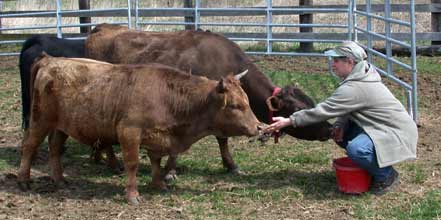 In my search for the perfect breed of cattle for my yard I had several criteria: They must not be too big - if one steer was more than my freezer could hold, thats too much. They must also be decent for milking. They must be thrifty on food and hardy for our cold New England winters. So I found the Dexter breed. I won't bore you with all the details of the first pair, but I did find them, along with the American Dexter Cattle Association, (link to them here) which will tell you more than you ever wanted to know about Dexters.
From my now many years of experience of raising them, I can say that one steer puts about 300 lbs of meat in the freezer on average. The meat is extraordinary, we've had chuck steaks as tender as fillet mignon from other beef. Even the older animals that we've had to butcher have tasted really, really good, and some were even as tender as meat from the store. One of the reasons, I think, that the meat is so good, is that they are fed mostly grass, which is what cattle are supposed to eat. I do feed grain and supplemential vitamins and minerals because our soils are depleted and the pasture is poor.
That's the other thing about raising our own meat; not only do I know exactly what they have been fed, but also that they did not have a lot of stress in their lives.
I sometimes have some beef for sale, either buy the side or by the cut. Please contact me to be put on an email list for notification of when beef will be available.
For a list of my current breeding cattle go to the website for the Amercian Dexter Cattle association (dextercattle.org) and do a pedigree search using my ADCA member # 2809.
As of spring of 2026 there are 8 registered cows, 2 non-registered cows, and one registered bull along with a variety of offspring.
Pigs
In the Spring of 2003, I had a goal of raising 5 pigs to eat. Well, I found 4 pink piglets at a farm down the road. Then I went to a dealer for the other one, and came home with two, because this female was different from all the rest. So I raised the 4 pink pigs, one brown pig and the black and white gilt. Pigs are fun! They like to play, especially in the mud. They like to lie in their water tank. They like people, especially the ones who feed them and rub their backs.
On and off over the years I sometimes raise a few pigs. I am not doing pigs until further notice.
Chickens
Chicken to eat is a good thing. But chicken from a factory can be toxic - from the food and medications they are fed, their crowded living conditions and the mechanical slaughtering which destroys the guts as they are hydraulically blasted out of the bird. Our chickens are raised in tractors: portable pens with open bottoms that are moved daily to give the hens fresh grass and bugs while still protecting them from predators. They have plenty of space per bird, and are hand cleaned to generate the most healthy and cleanest meat we can provide. We raise no more than 75 birds per season, and generally have whole, fresh or frozen chickens for sale from July through October. Birds range in processed weight from 4 to 7 pounds. I am raising a few chickens in 2026
(Take photo of new chicken tractor, after it's repaired!)
Eggs
No egg has a yolk quite so yellow, and so firm and a shell so hard as one that comes from a chicken allowed to forage on grass and insects and fed a variety of foods. I don't sell eggs, but if you come visit, and I have extra, I will give them away.
Turkeys
In years that I raise turkeys, I usually take orders in late October. We process them on the farm, the sunday before Thanksgiving so that everyone gets a fresh bird. Usually I raise Broadbreasted Bronze turkeys, and our finished weights run from 20-38 pounds. Turkeys are being grown in 2026.